This Introverted Coastal Home in Karnataka is Rooted in Childhood Memories
Mallige, named after the Jasmine flower, is an introverted sanctuary that draws its core spatial experience from a profound childhood memory of the architect Rohan Salian.


For Rohan Salian, Principal Architect of Blacksheep Farm studio, Mumbai is defined by its accelerating pulse and vanishing quiet. While Mangaluru, conversely, slows down to a leisurely stroll, and the sounds of the sea. “As kids, our vacation used to be coming to Mangaluru. And, as a city kid, I hated slow living,” Rohan admits. “But, two decades later, when I went to my hometown in Mangaluru, and walked down the beach, that’s when it struck me that I should be getting back to my roots, my culture, and embracing the importance of slow living,” Rohan recounts, putting forth his perspective on these contrasts, through a long story short. And, as a result, he ended up building his home in his hometown, Yermal, where the land meets the sea, and his present meets the past.
Inspired by the Coastal Memories
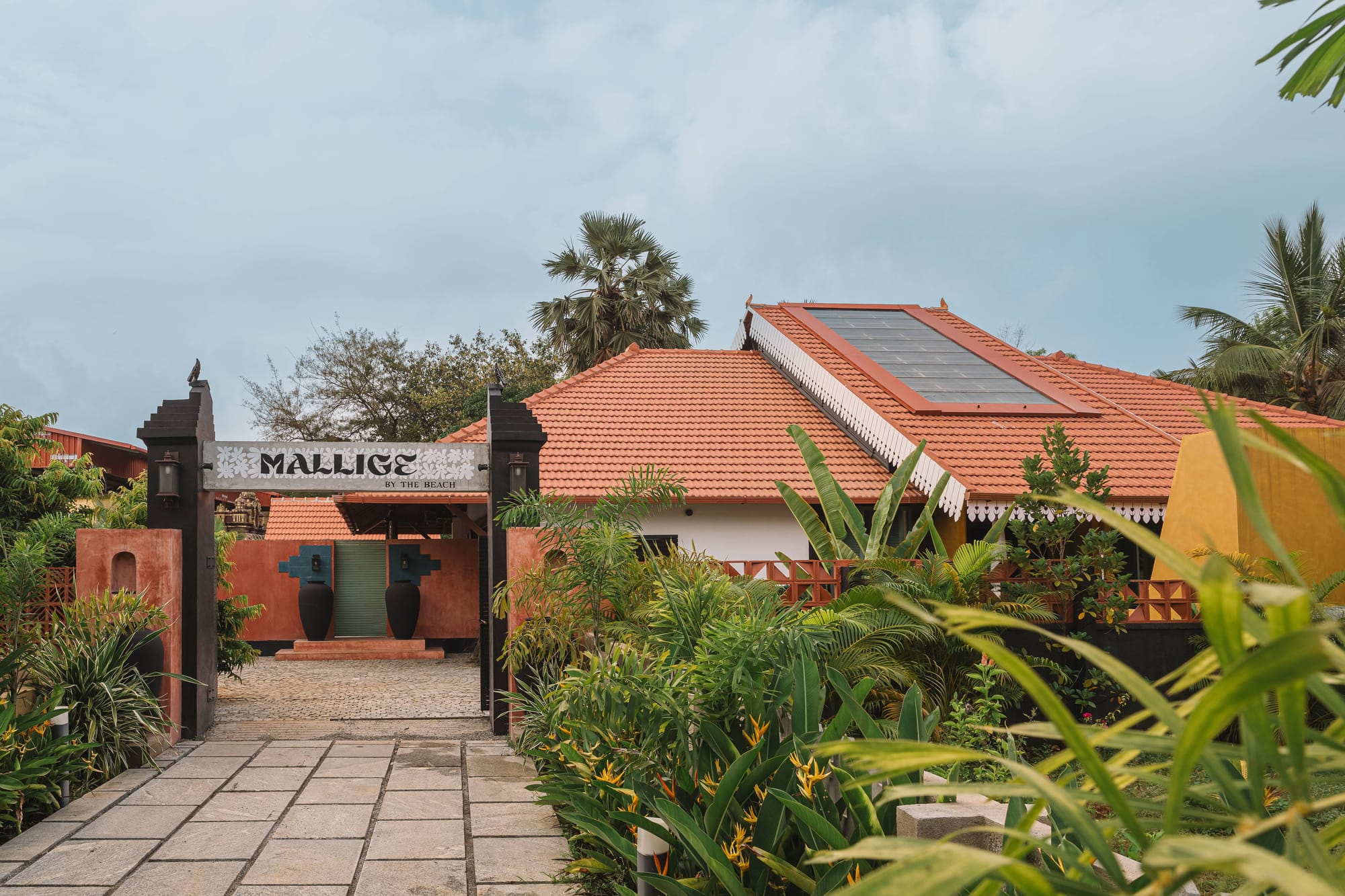
‘Mallige’, as named after the jasmine flower, sparked from a faint, sensorial fragment of childhood: the vastness of a long-vanished Mangalore tile factory. Rohan remembers being completely enveloped beneath a double-height roof where terracotta tiles rested on an exposed lattice of wooden trusses. The air was thick with the scent of sun-baked clay and ash, and the space felt uninterrupted, raw, and completely free. This nostalgic spatial memory became the enduring seed for Mallige.

“Mallige is an anti-house. It is like a warehouse, animated with colours, raw materials and textures,” architect Rohan puts forth. Situated in a dense coastal town, just inland from the Arabian Sea, the site was hemmed in by concrete villas, offering little opportunity for outward engagement. The architecture, therefore, is deliberately introverted. While most old houses in the region share a charming, expressive palette of deep ochres and sea blues, Mallige is a quiet rebellion. It is an intentional, contained world that unfolds inwards, prioritizing private sanctuary and communal life.
Reinterpreting the Coastal Cues
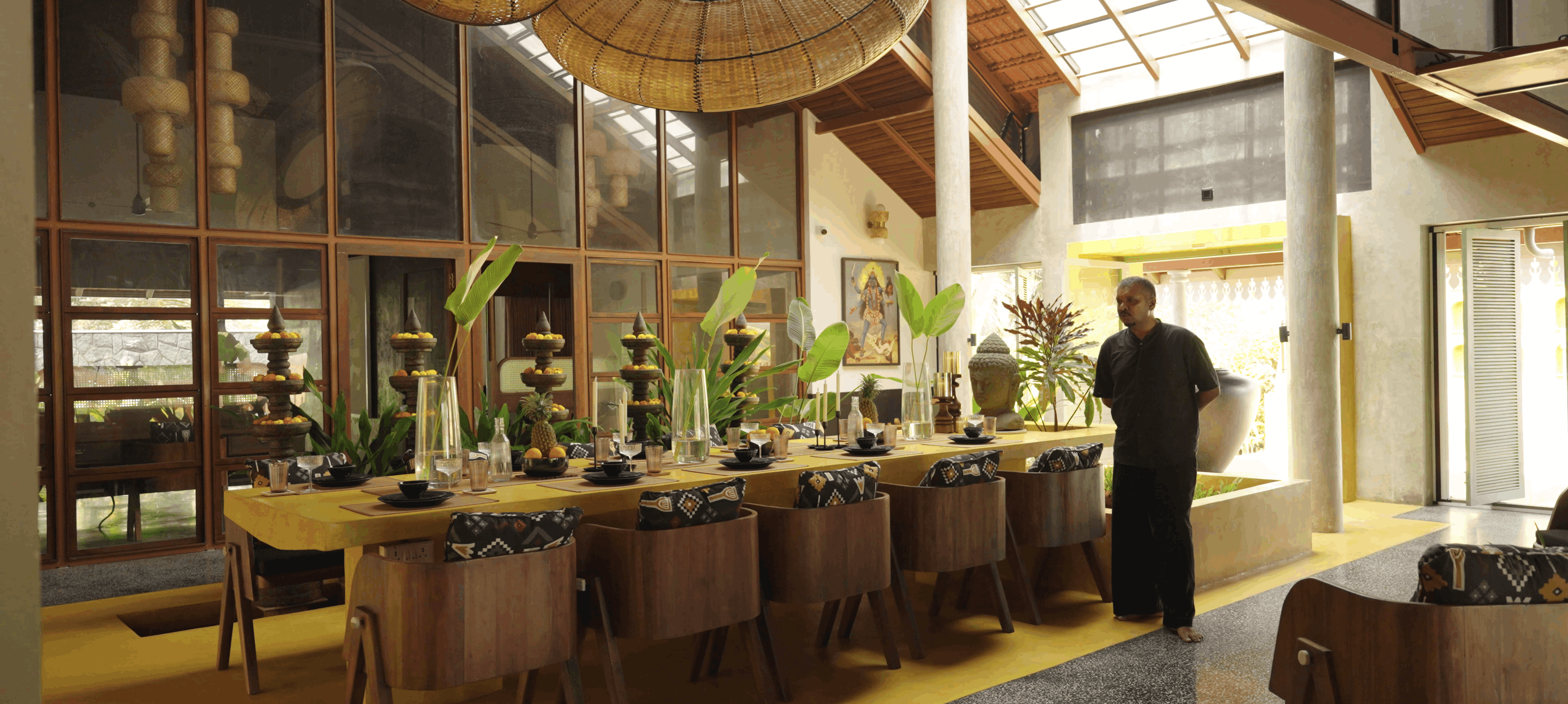
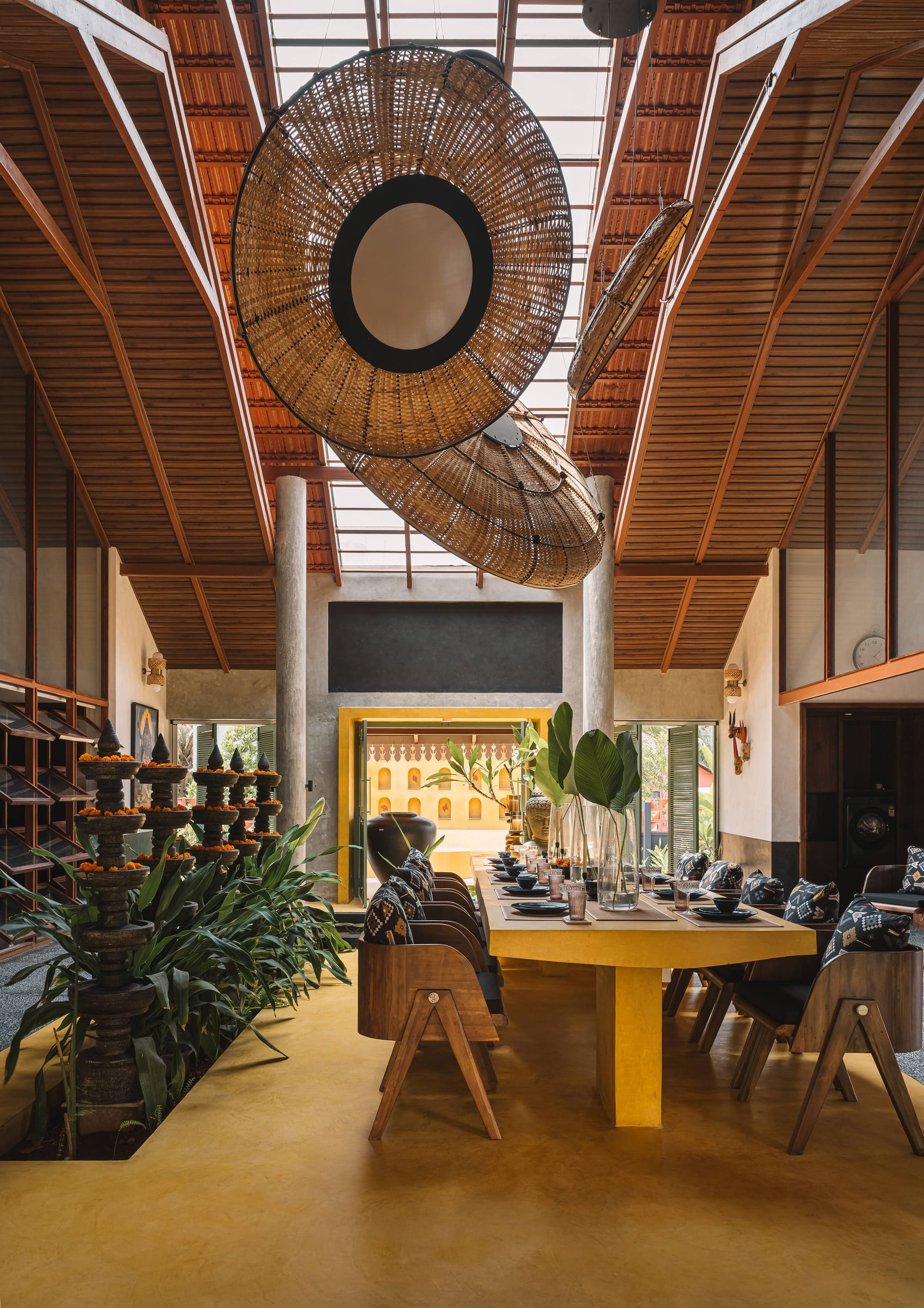
Rohan’s design became a tribute to the spirit of those older coastal homes by abstracting and reinterpreting the vernacular, primarily through the unconventional centrality of the communal spaces. The very heart of the house is the dining area, placed at the centre of the plan. This sunlit volume mimics the grand scale of an ancestral courtyard, complete with a lily pond and a champa tree rising toward a large skylight above. The planning is intentionally open, structured around the dining area – which acts as a bold axis that guides movement. This central space spills outward on both sides, morphing into low built-in seating zones that blur the lines between inside and outside, movement and stillness. The traditional-looking roof, a high, sloping structure lined with Mangalore tiles, reinforces the scale and anchors the entire composition. To ensure consistent thermal comfort, the roof above the dining courtyard is subtly raised to introduce a clerestory band of ventilators, allowing hot air to escape passively.
Reinventing the Coastal Language
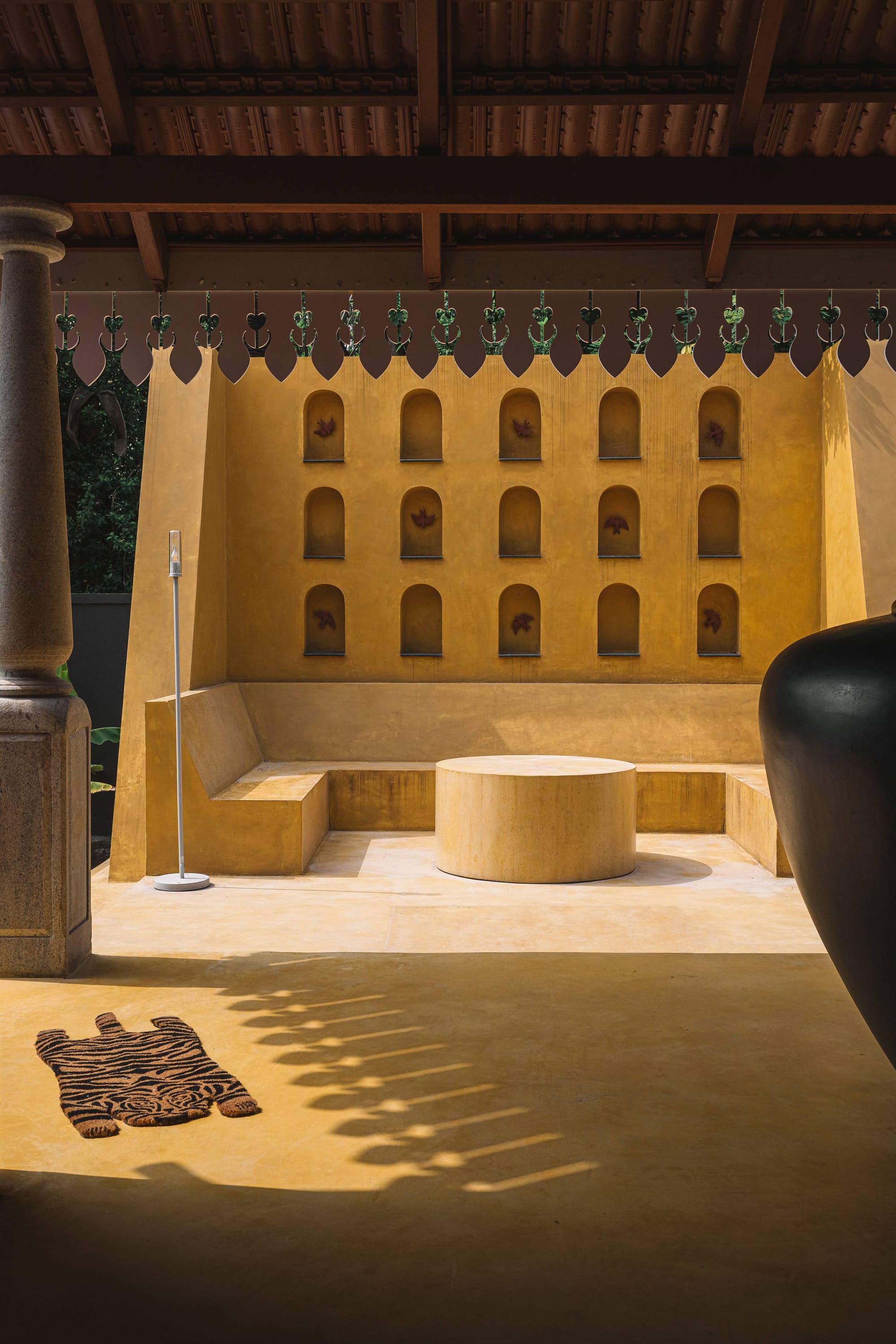
“When we started designing this home, we were very sure that we wanted to make it look aged”, Rohan claims. Chosen to reflect this aged, lived-in aesthetic, the materials reinforce imperfection and the passage of time. Even the home’s distinct spatial language is established by its flooring: a custom yellow oxide cement floor cuts through the plan like a vibrant, defining axis, marking the central dining space. This vivid core separates the adjoining living area and bedrooms, which are finished in contrasting black terrazzo. The dining table itself is a custom yellow cement monolith—a cantilevered slab extended to act as a planter box at one end. The entire combination of lime plaster, oxide finishes, grey granite, terracotta tiles, and reclaimed custom-designed wood furniture contributes to a tactile, timeworn sensibility.
Responding to the Coast
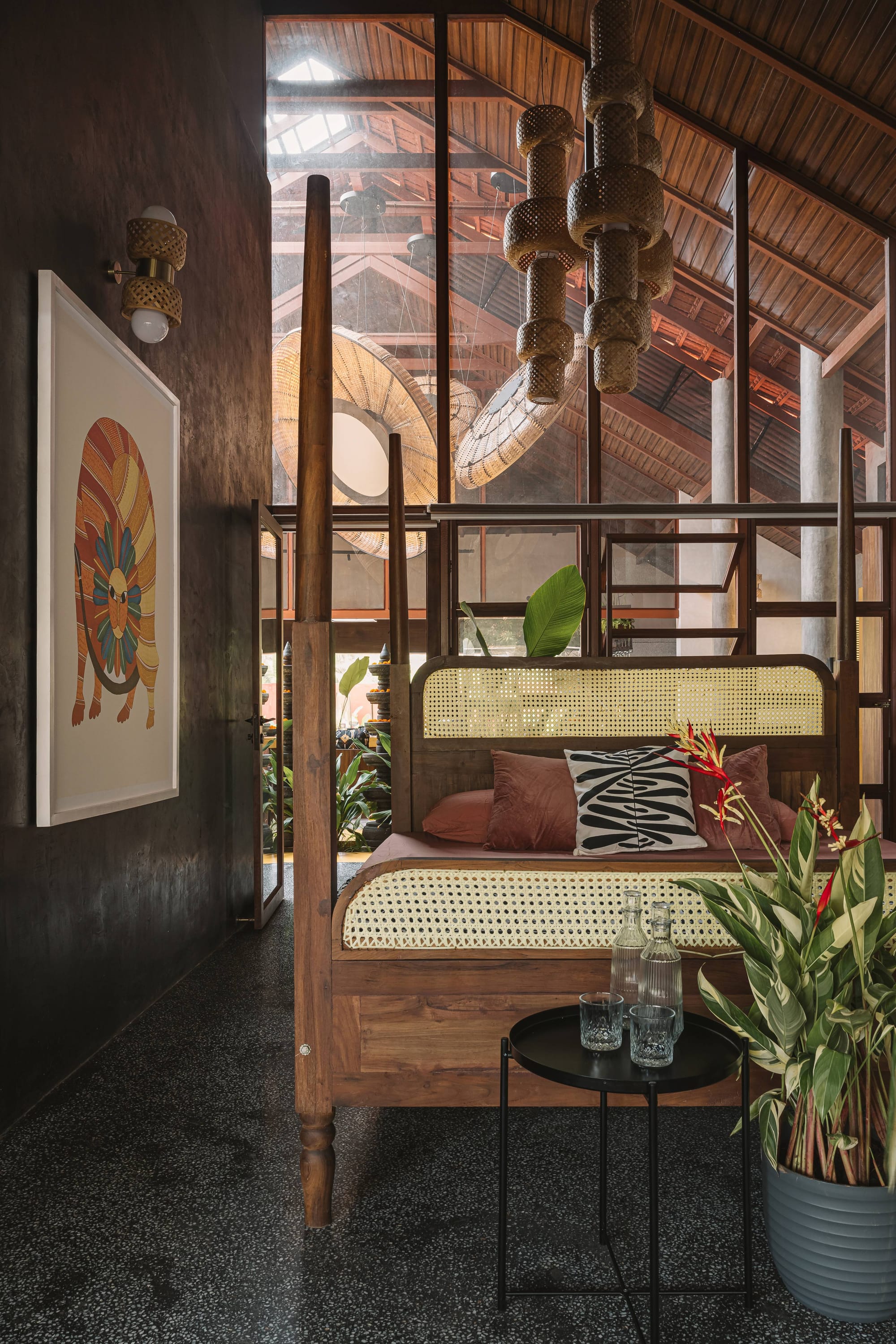
Over these colourful surfaces lie the subtle, coastal aesthetic touches that add layers of poetry. These visual details ground the home in its location: oversized bamboo pendant lights, designed in the form of abstracted lily pads, hover over the dining space. These lights are intentionally installed at varying angles to play with scale and dramatically enhance the height and volume of the space. Further, the house breathes effortlessly, its open planning and thoughtful orientation allowing for consistent cross ventilation. Above the unconventional dining courtyard, the roof is subtly raised to introduce a clerestory band of ventilators, a crucial element that allows hot air to escape passively, thereby maintaining thermal comfort. The roof structure itself—a high, sloping form lined with traditional Mangalore tiles —features metal trusses, painted with marine-graded paint to prevent corrosion.
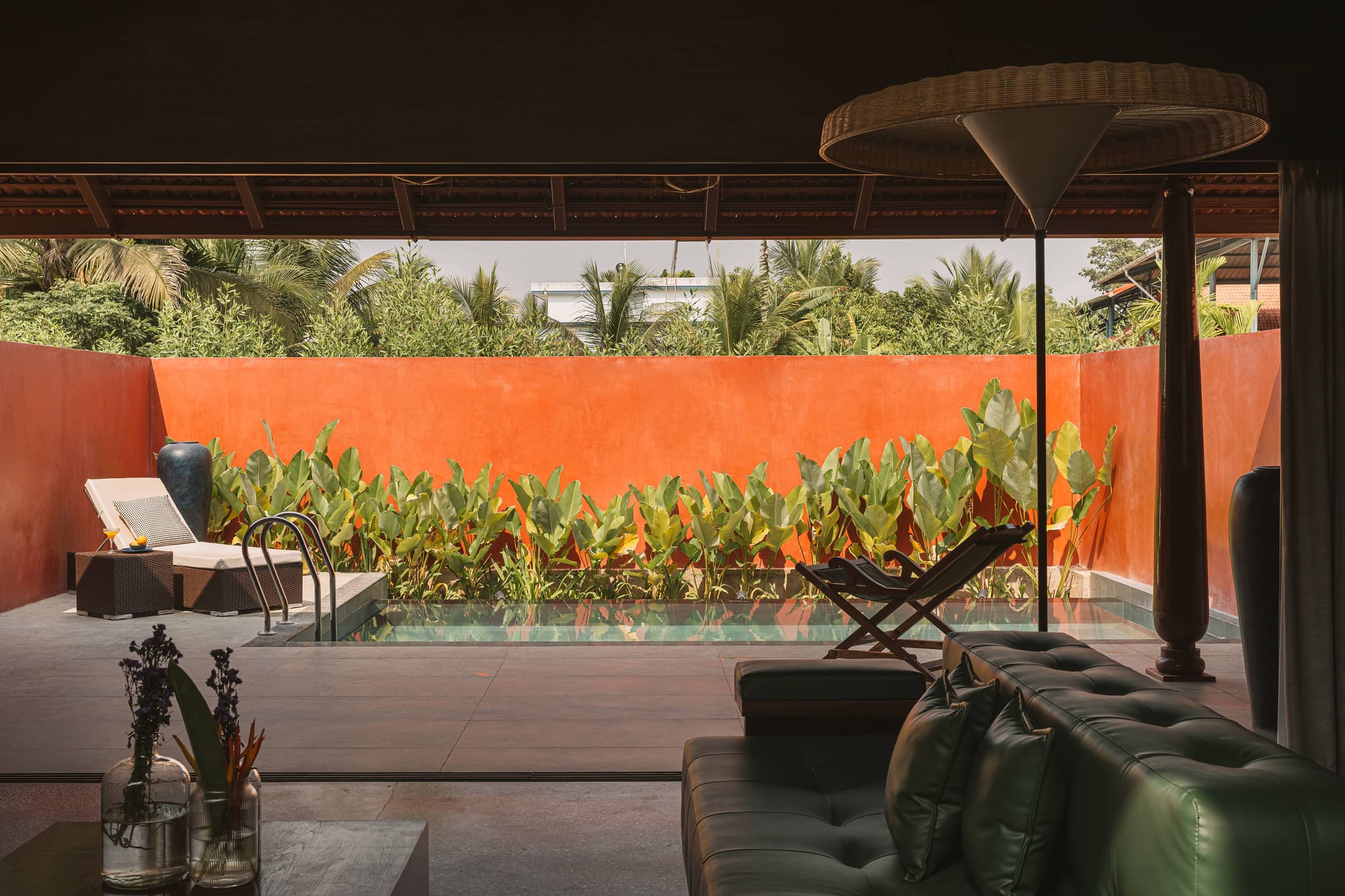
Therefore, in every sense, Mallige seeks to be strongly unconventional. “Mallige questions what a home can be,” Rohan says. But, despite this rebellion against repetition and template living, Mallige never fails to root itself to the context, the culture, and the climate of the coast, ultimately invoking that cherished, raw spatial fragment of childhood and transporting us, moment by moment, back into the serenity of the past.
Watch the complete video and access the PDF eBook on Buildofy.