Discover a Home That Embraces Slow Living in the Shadow of Nandi Hills
Featured in Buildofy’s coffee table book, 10 Homes Bengaluru, Villa Soham reads as a house that instinctively slows life down.
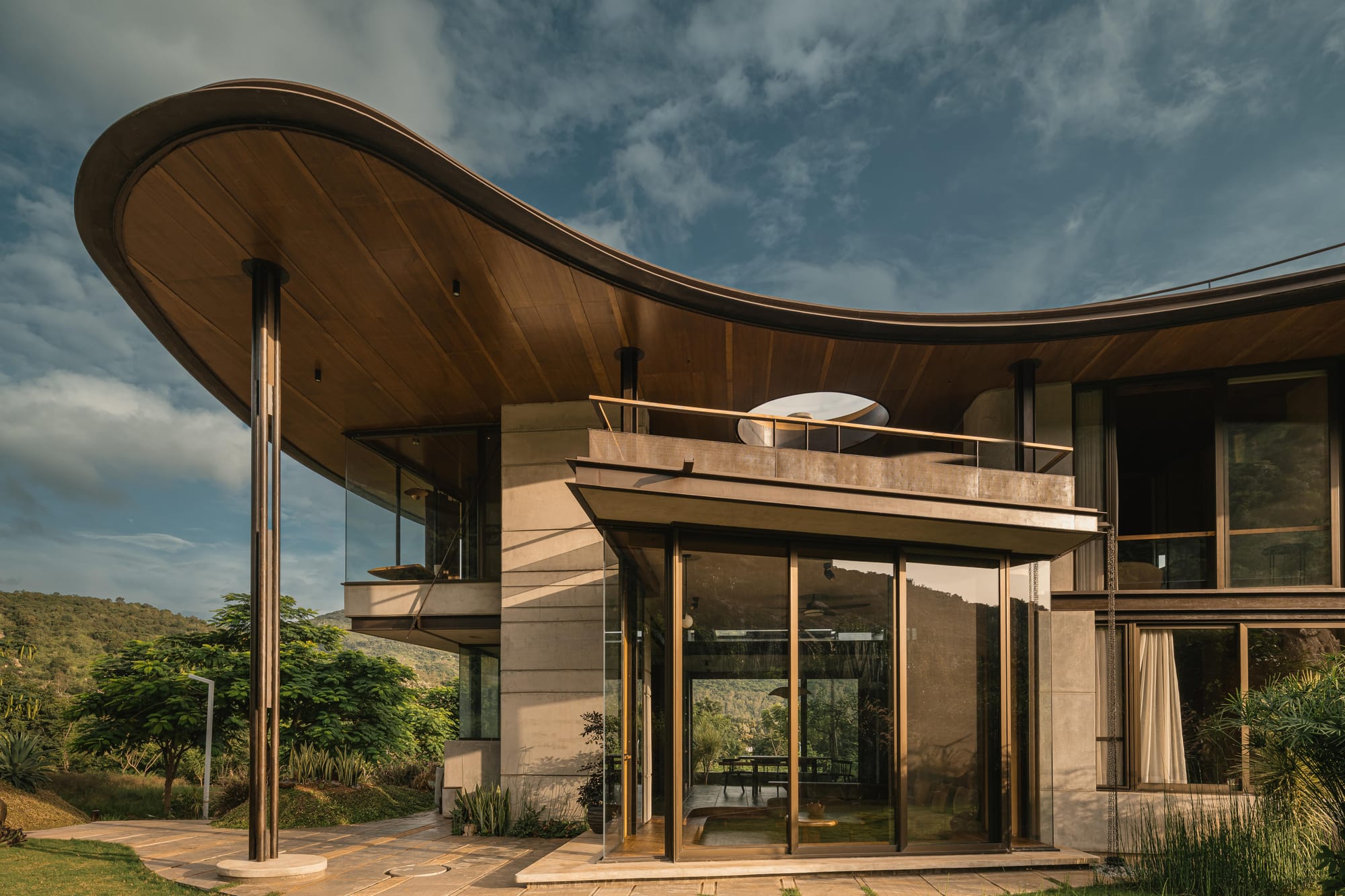
Resting near the foothills of Nandi, where gated developments gradually dissolve into open terrain, Villa Soham positions itself as a quiet threshold between the cultivated and the wild. The architecture does not assert itself; instead, it recedes, allowing the landscape to lead. Contours, rock outcrops, distant ridgelines, and prevailing breezes establish the rhythm of inhabitation, giving the house a pavilion-like lightness rather than the presence of a sealed mass.
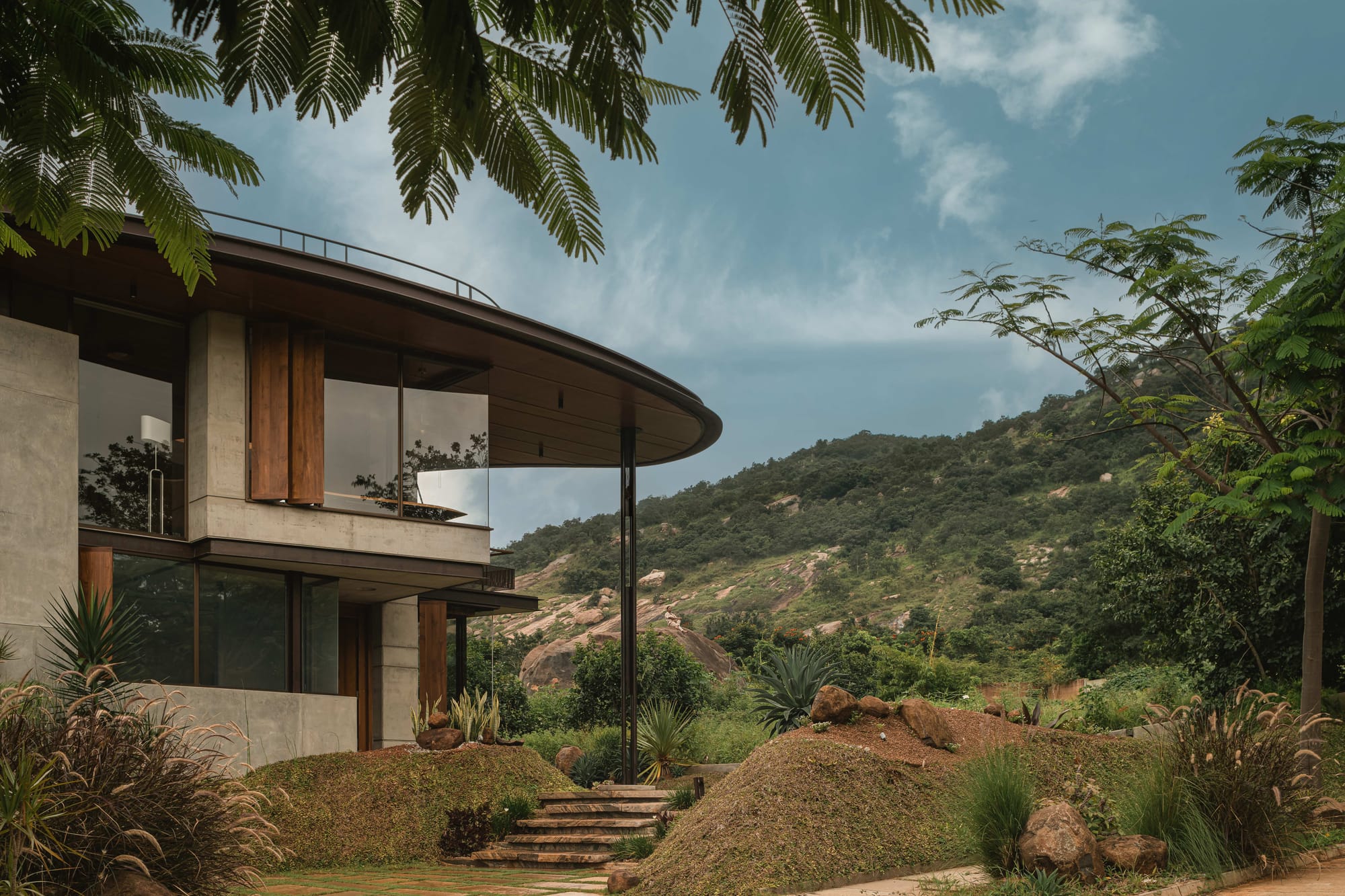
As architect Meeta Jain, Principal architect of Meeta Jain Architects, notes, “I never wanted the house to dominate the site. The land already had a strong voice. My role was simply to listen and respond.” This attitude appears in the building’s placement along the edge of the plot, freeing the foreground for gardens and uninterrupted views. Existing boulders remain embedded within daily sightlines, anchoring the dwelling to the terrain rather than separating it from it. The roofline blends gently into the hills, echoing their slopes instead of asserting a rigid geometry. From multiple vantage points, the structure reads less as an insertion and more as a quiet extension of the ground.
Arrival becomes a deliberate act of recalibration. A monumental gateway slows movement before drawing one inward. Beyond it, a layered wooden door recalls the thickness and weight of old fort entrances, making entry feel ceremonial rather than transactional. The transition from wilderness to interior unfolds gradually, allowing the senses to adjust before crossing the threshold.
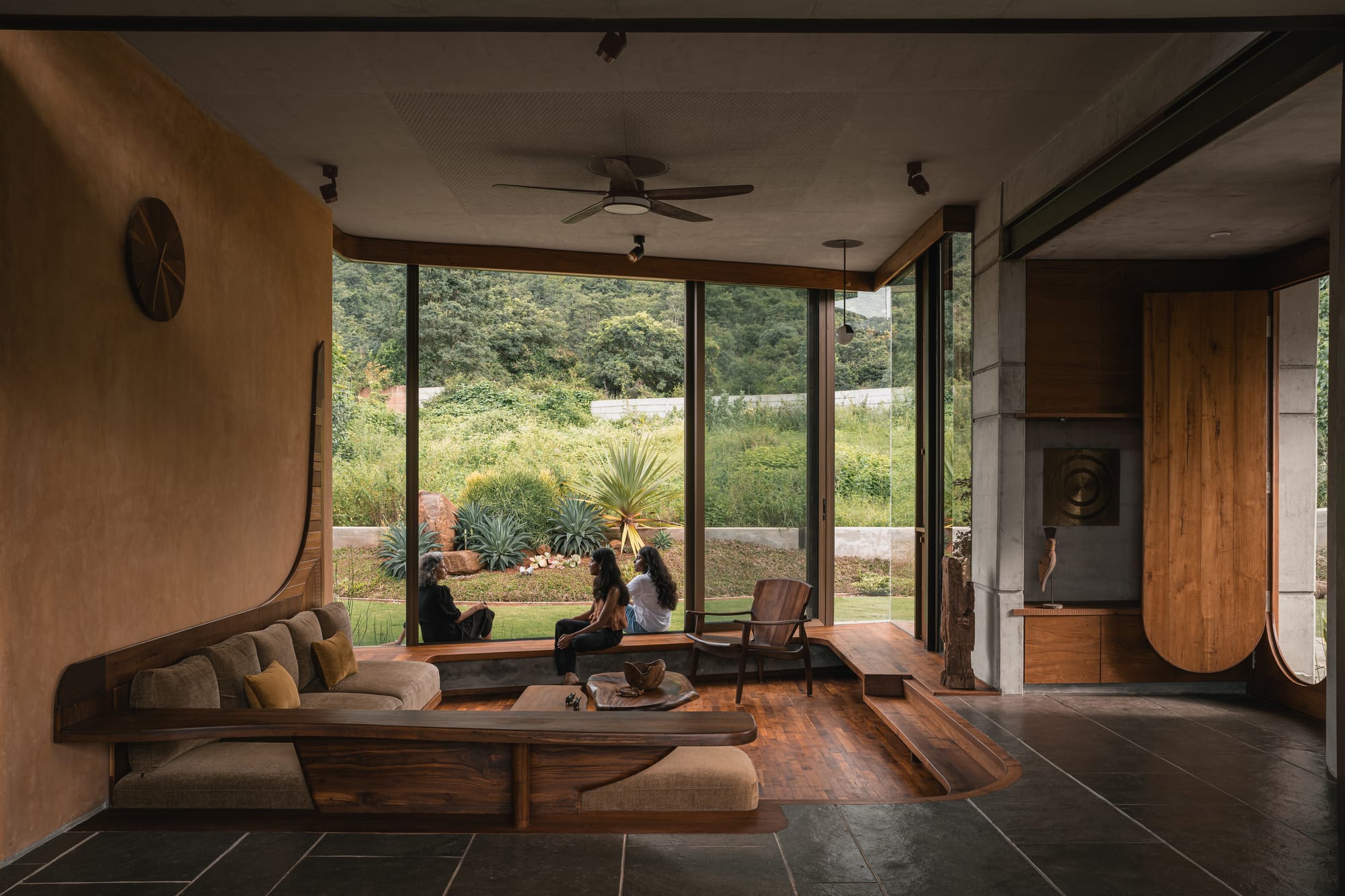
Inside, the living room settles into a slightly sunken datum that grounds the body and softens perception. Seating is not introduced as furniture but carved into the architecture itself, forming informal katte-like edges along the windows where conversation naturally gathers. Warm oxide-finished walls lend the interiors a natural & rustic quality, that matures with time, while ash-gray stone flooring laid in a Corbusier pattern with a hand-chiseled Lepatra finish introduces a tactile, earthbound surface underfoot. The textured stone catches light unevenly, reinforcing a quiet material authenticity. The room behaves less like an enclosure and more like a shaded clearing within the house.
“Spaces should invite pause,” Jain explains. “If a house only supports movement and efficiency, it forgets the human need for stillness.” This belief extends into the dining and kitchen areas, which remain visually connected to the landscape. Openings are framed with restraint rather than excessive glazing. As Jain notes, “When building in a site as beautiful as this, one of the most meaningful gestures is to provide an unobstructed row of windows, allowing the eye to trace the skyline of the hills without interruption.” The continuous band of glazing, therefore, maintains a measured, uninterrupted relationship with the horizon while enabling cross-ventilation and thermal comfort.
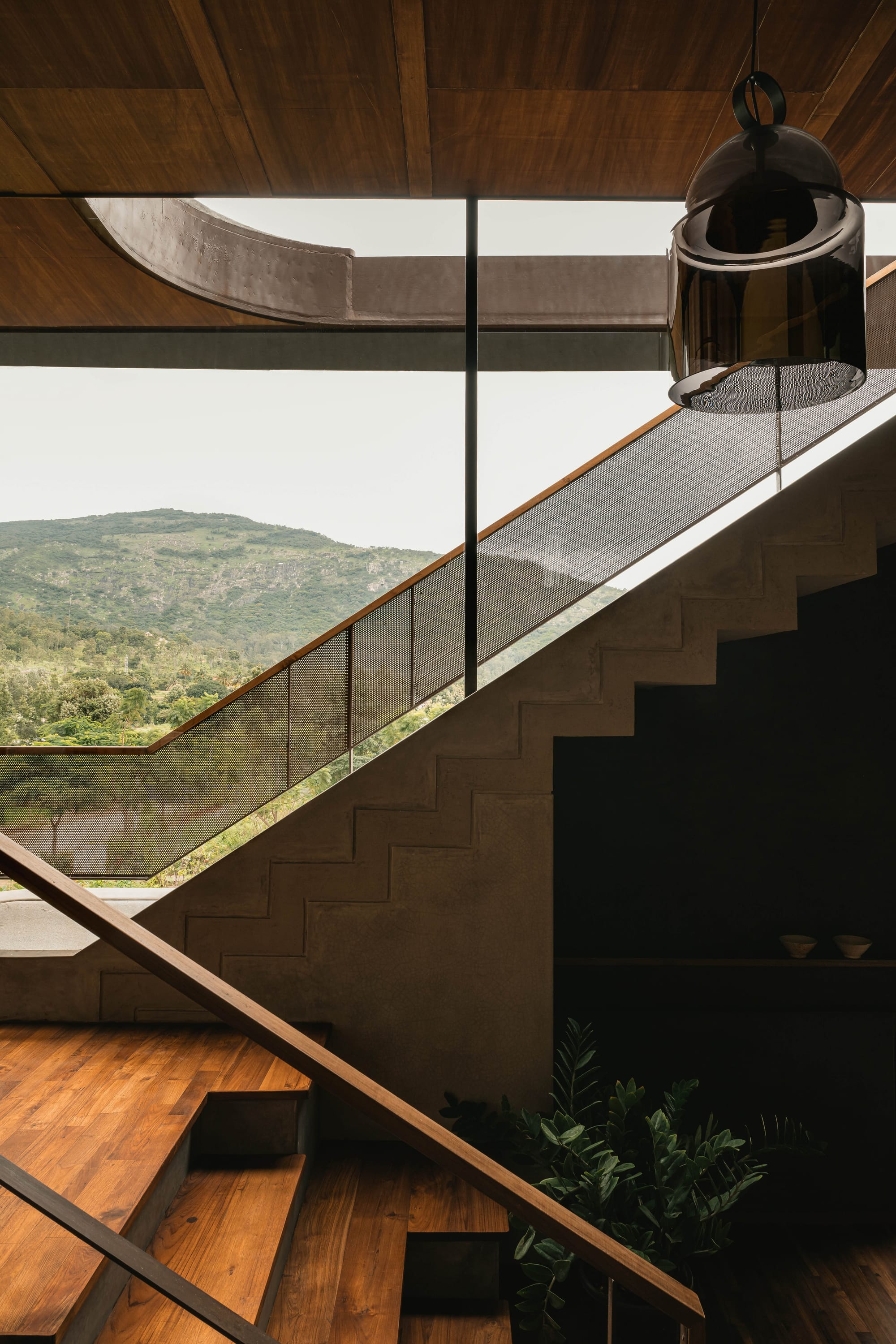
A sculpted staircase doubles as seating and pause space, transforming vertical movement into an event rather than a transition. Above, a slender bridge stitches the rooms together while preserving visual continuity across levels and toward the outdoors.
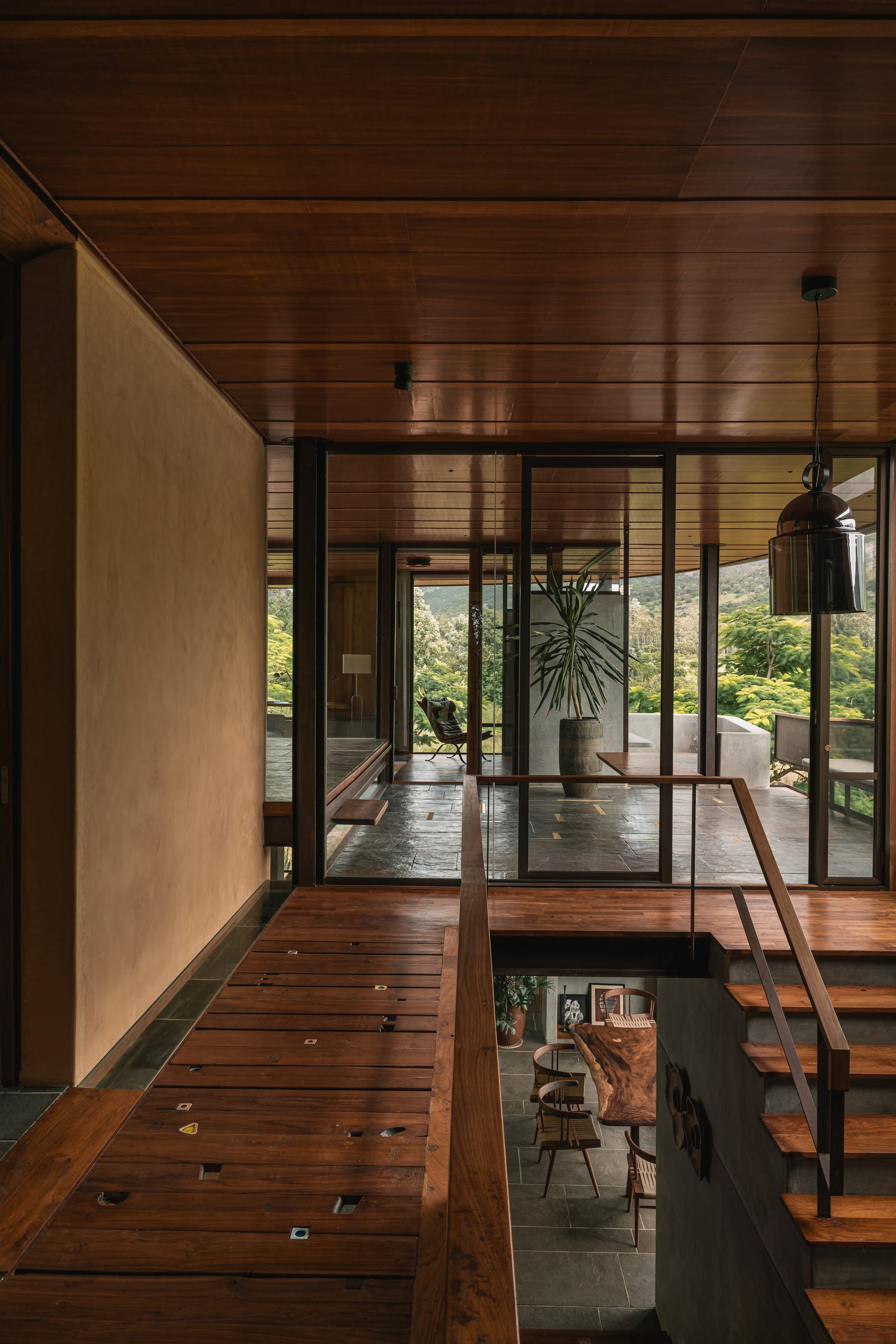
Bedrooms orient toward the hills so that the landscape becomes the first encounter each morning. Recycled wooden louvers temper the western sun while integrating storage and seating, merging climatic control with daily function. Throughout the house, furniture emerges from joinery and built-ins rather than loose additions.
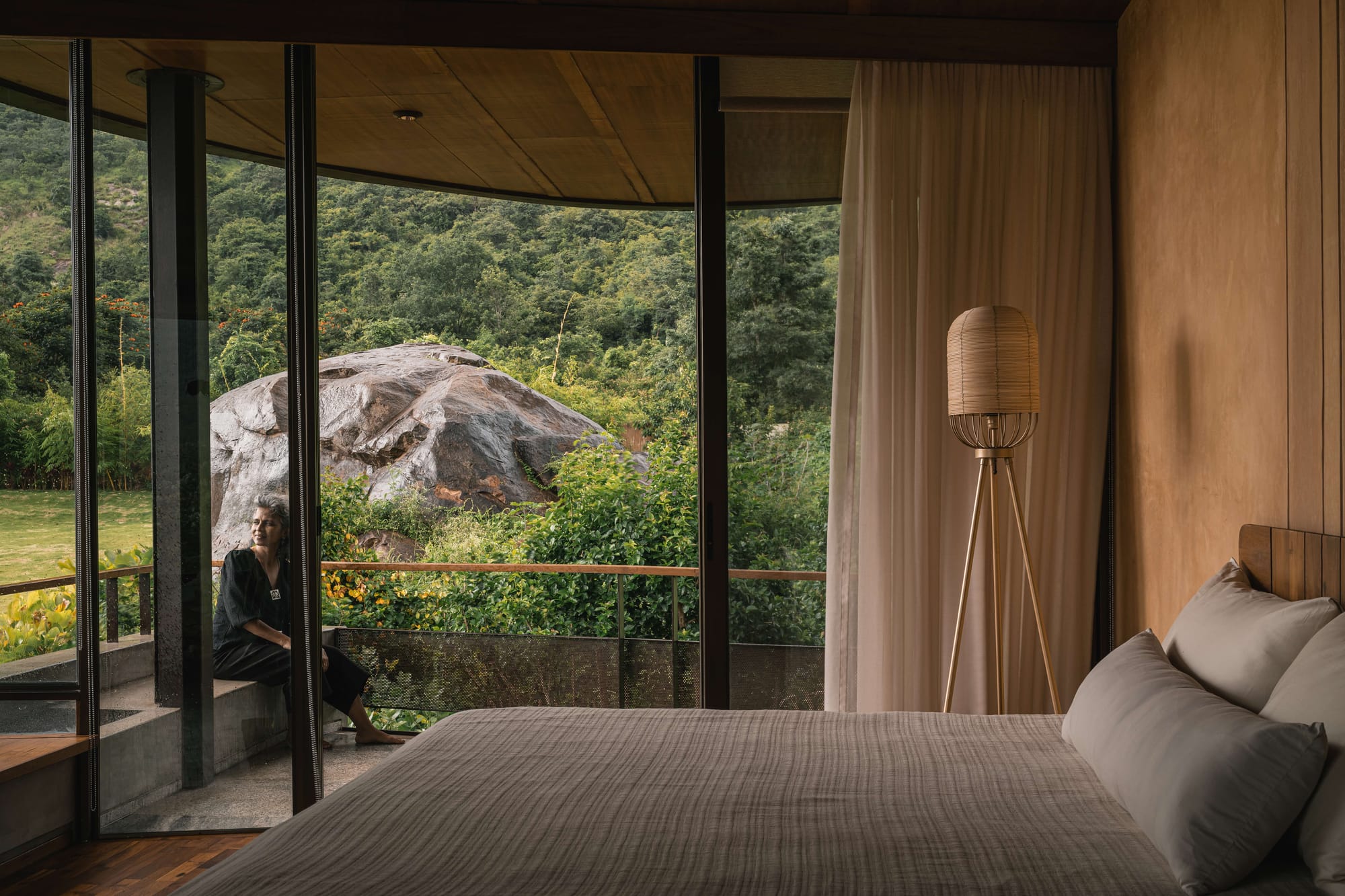
Structurally, slender steel members and exposed concrete slabs form a restrained frame that keeps the plan open and adaptable. Overhead, a roof assembled from decking sheets and plywood cladding reads as a continuous sculpted plane that modulates light and shade rather than merely providing cover.
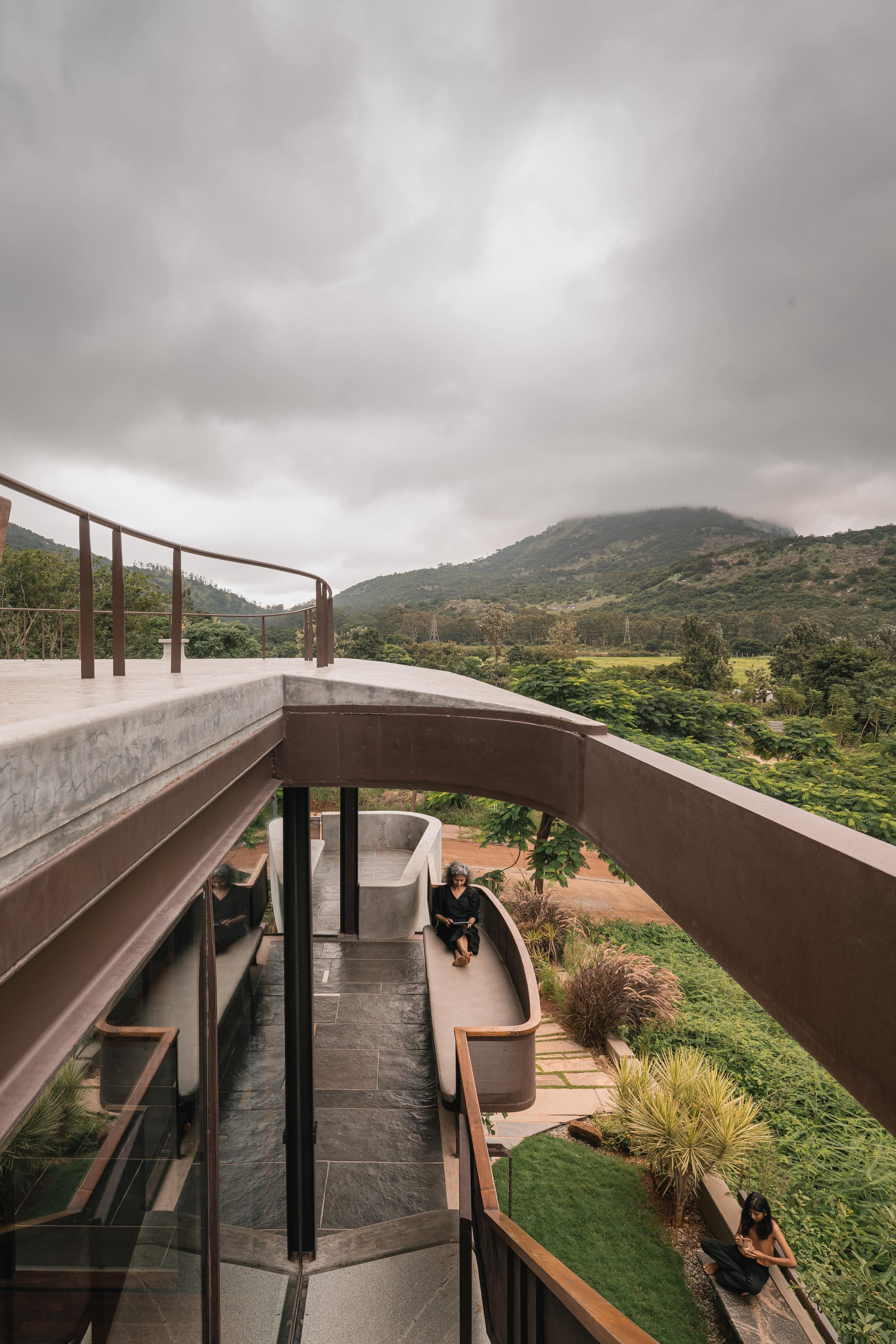
The sequence rises into the upper level, where the north–south spine expands into a vast covered deck conceived less as a terrace and more as a deep verandah or machan. Acting as a climatic buffer, it absorbs wind, rain, and drifting shadows while functioning as an outdoor living room. Built-in platforms, low benches, a traditional jhoola, and even perches formed from perforated metal railings encourage varied postures of rest and gathering. Here, the air moves freely, sound softens, and the hills feel immediately present.
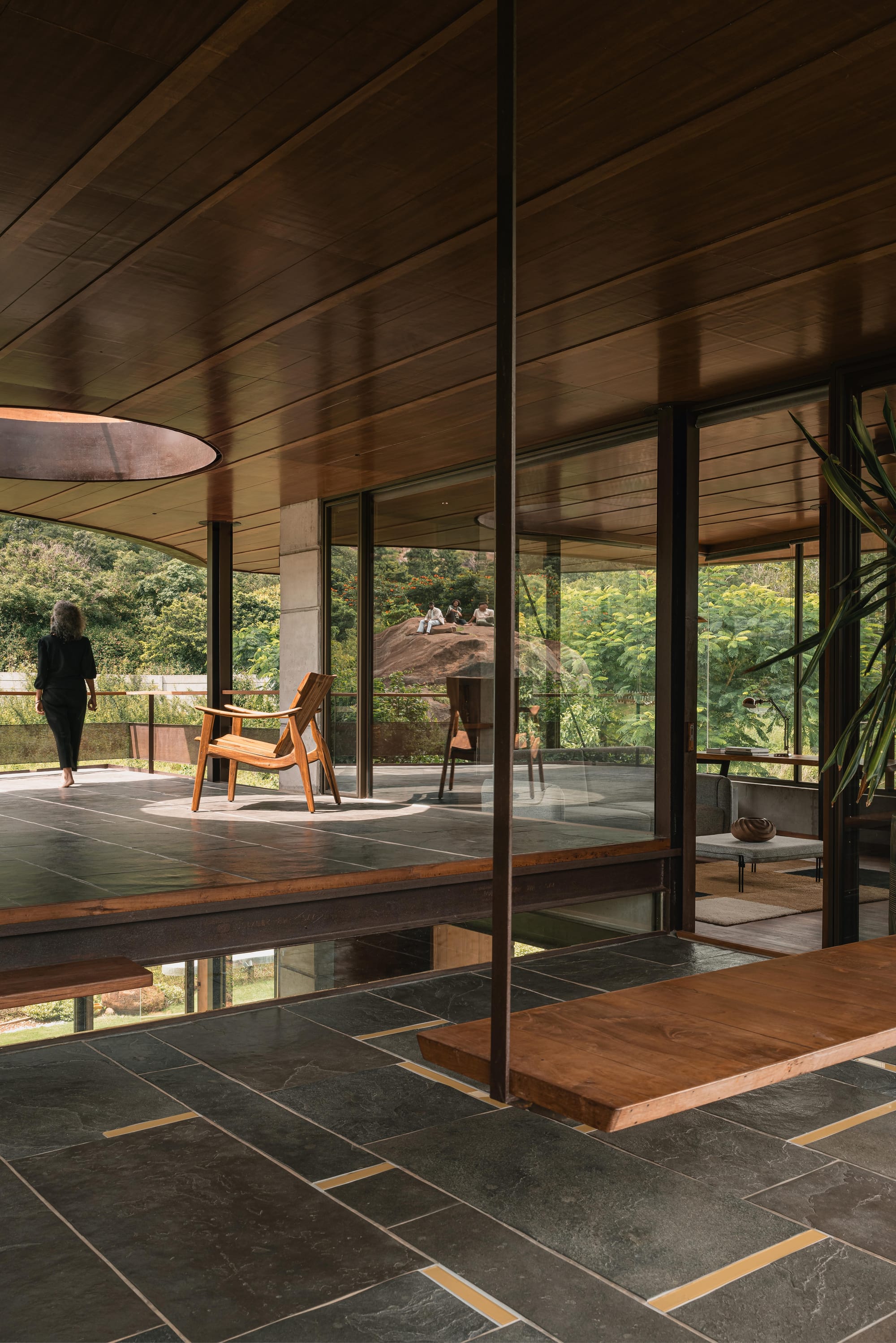
Beyond this semi-covered layer, the architecture releases itself completely into the sky. The terrace remains fully open, forming an unobstructed plane that functions almost like an observatory. At its center, a circular oculus punctures the surface, channeling daylight deep into the house below and marking the slow passage of time. Across the terrace floor, sweeping bands of contrasting stone form a radial mosaic, tracing fluid, celestial patterns that subtly echo the movement of the sun and moon. The ground itself becomes graphic and experiential rather than merely finished. A slender cylindrical tower rises alongside housing services while acting as a quiet vertical marker against the otherwise horizontal landscape.
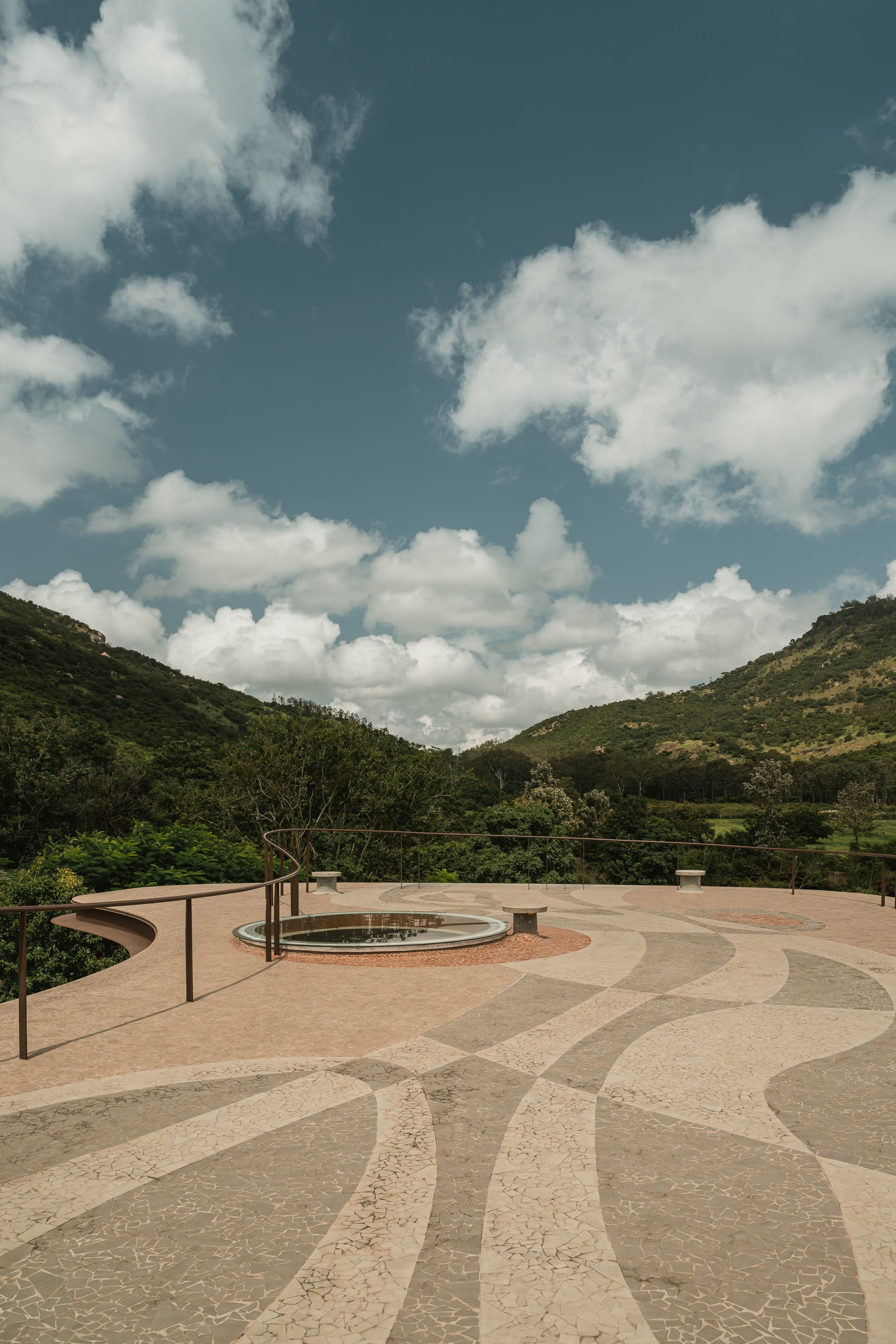
“For me, architecture is not about control,” Jain reflects. “It is about creating conditions where life, light, and weather can participate in space.” Here, that participation feels direct and elemental. With no roof overhead, light, wind, and cloud cover continuously reshape the experience, allowing the house to dissolve into the terrain one final time.
This home avoids visual excess and formal bravado. Instead, it relies on restraint, tectonic clarity, and environmental intelligence. Villa Soham ultimately demonstrates how residential architecture can cultivate attentiveness through measured design, allowing land, climate, and habitation to remain in quiet, enduring dialogue.
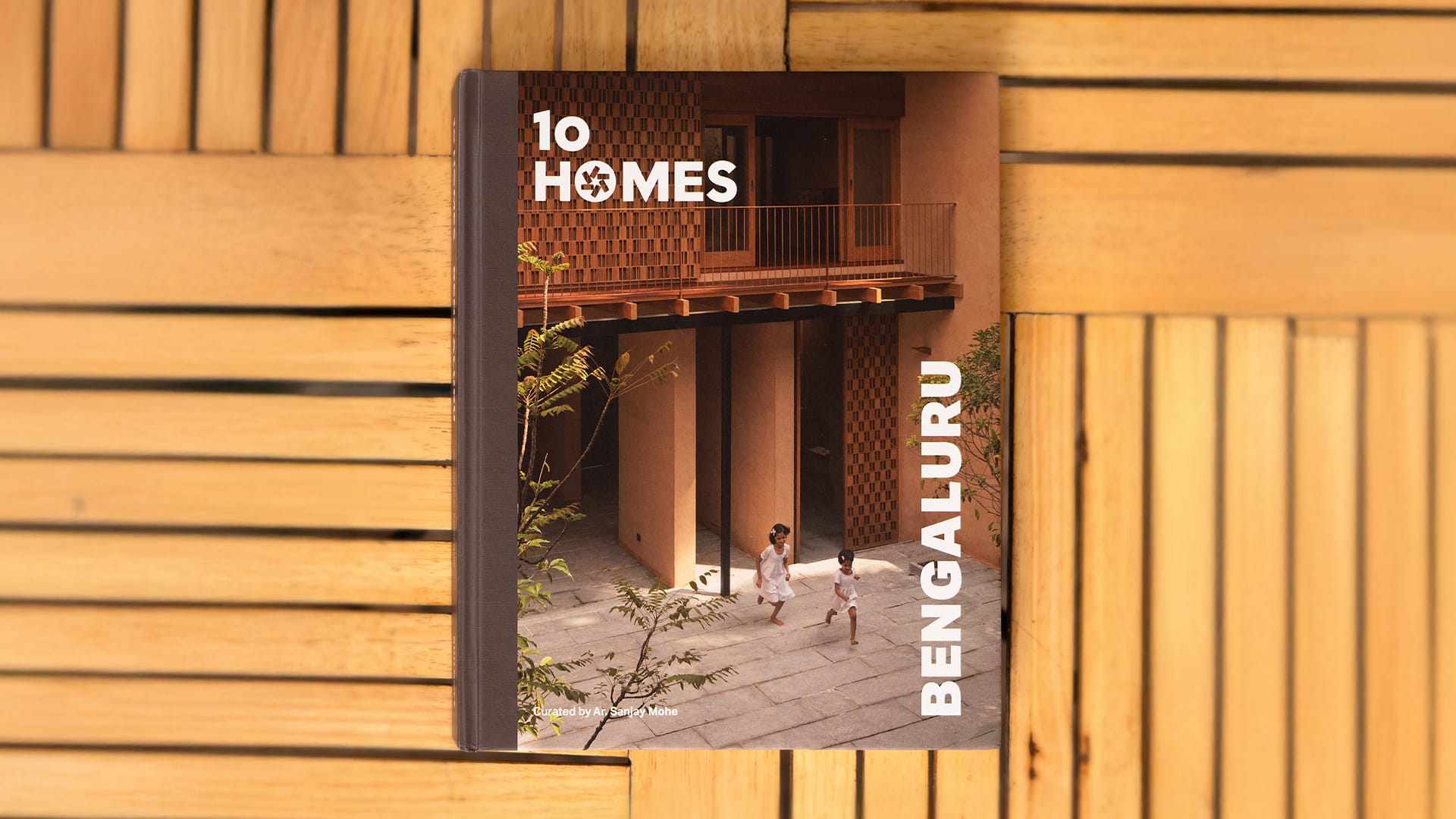
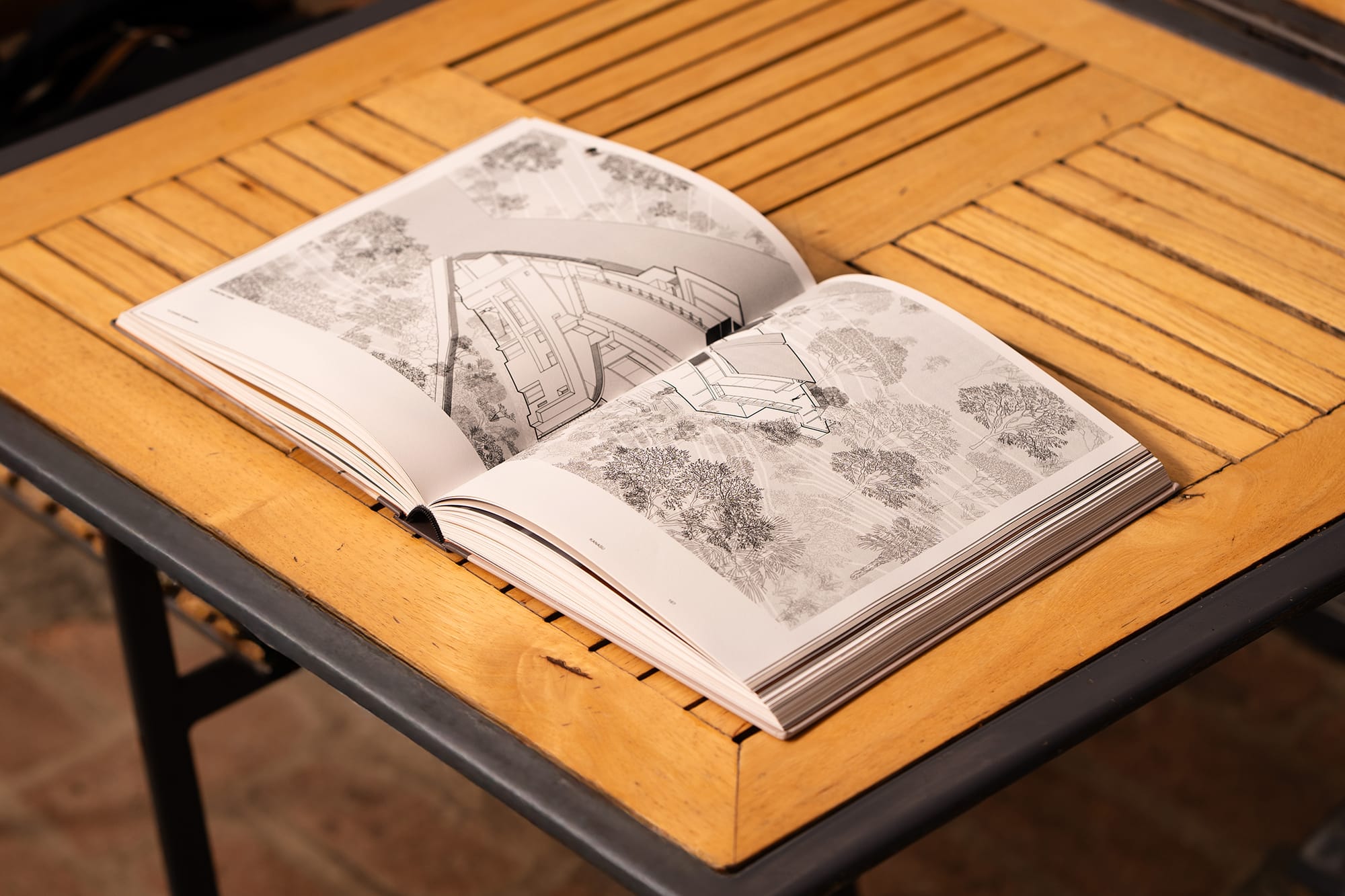
Buildofy is celebrating 10 Years of Architecture Storytelling with the introduction of a limited edition coffee table book - 10 Homes Bengaluru. Pre-Order Your Copy on Buildofy.